

Buying a bed online is convenient, but it comes with one obvious problem: you cannot physically see how it will sit in your room before it arrives. Photos give you a general idea, the dimensions on the product page give you numbers, but turning those numbers into a real sense of whether the bed will actually work in your space takes a bit more effort.
This is the step most people skip, and it is the step that causes the most regret. A bed that looks perfectly reasonable in a product photo can feel completely different once it is sitting in your actual bedroom, especially if you have gone for a size that is slightly too ambitious for the space, or chosen an ottoman storage bed without checking whether you have room to open it.
This guide walks through exactly how to measure your bedroom properly before you buy, so the bed that turns up is the bed that actually fits.
Most people measure the bed itself but forget to measure the room around it. It feels intuitive to think that if your room is, say, three metres by three metres, a king size bed will obviously fit. But fitting is not just about whether the bed physically goes in the room. It is about whether you can still walk around it, open the wardrobe, get into bed comfortably from both sides, and in the case of storage beds, actually use the storage without rearranging furniture every time.
Taking fifteen minutes to measure properly before you order saves you from the much more painful experience of a bed arriving that technically fits but makes the room feel cramped and impractical.
Start with the basics. Measure the length and width of the room, wall to wall, in at least two places, because older homes in particular are rarely perfectly square. Note down the smallest measurement you get, since that is the one that matters when you are working out what will fit.
Also note the position of doors, windows, radiators, and any fixed features like alcoves or chimney breasts. These all affect where a bed can realistically go, regardless of how much open floor space the room has on paper.
Every bed has three key measurements: the dimensions of the mattress size it is designed for, the overall footprint of the frame including the headboard, and the height, particularly relevant if you are choosing a tall headboard or a bed with a deep base.
Standard UK bed sizes and their approximate frame footprints, including a typical headboard, are useful to keep in mind:
These are approximate because exact dimensions vary slightly depending on the headboard style and base depth, but they are a solid starting point for planning.
This is the part people miss most often. A bed needs space around it to actually be usable, not just space to exist in the room.
As a general guide, aim for at least 60cm of clear space down each side of the bed where you will be walking or getting in and out. This is the minimum for comfortable movement. If you can get 70 to 80cm, the room will feel noticeably less cramped.
At the foot of the bed, aim for at least 60cm as well, more if the room is also a walkway to a door or en suite. If you are considering an ottoman bed, this measurement becomes critical, which brings us to the next point.

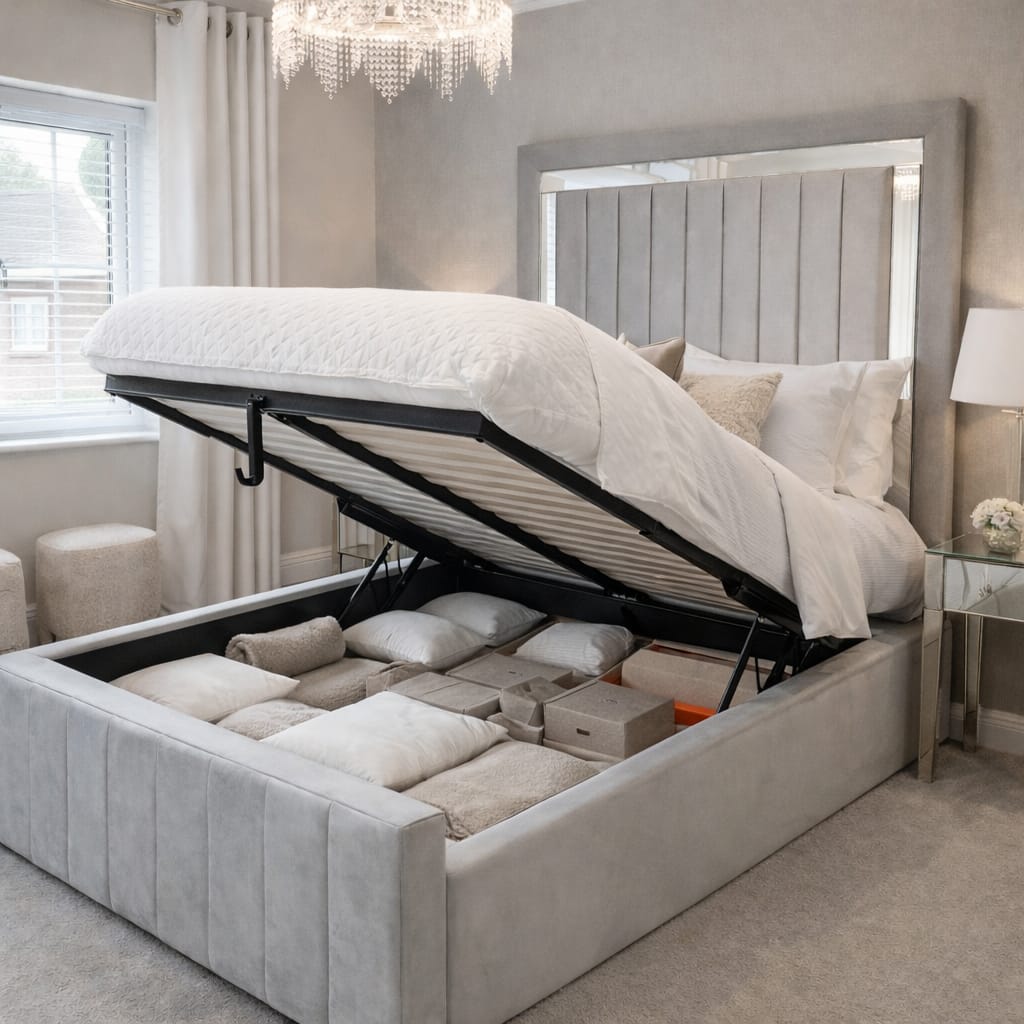
Ottoman beds at Sleep World Furniture lift from the foot end. This means when you want to access the storage, the entire base lifts upward from the bottom of the bed, hinging near the headboard end.
To use it properly, you need clear floor space at the foot of the bed, ideally at least 80 to 100cm, so the base can lift to its full height and you can comfortably reach inside without the lid catching on a wall, a wardrobe, or anything else positioned at the end of the bed.
If your bed is going to sit with the foot end close to a wall, a window, or a piece of furniture, measure that gap carefully before ordering. It is the single most common fitting issue with ottoman beds, and it is also the easiest one to avoid if you check it in advance.
If you know the foot end of your bed will be tight on space, a drawer bed is often the more practical choice, since the drawers pull outward from the side rather than requiring vertical clearance.

It is easy to measure the bedroom itself and completely forget about how the bed is going to get there. This matters more for some bed types than others, but it is always worth checking, particularly if you live in a flat, a period property, or anywhere with narrow staircases or tight hallway turns.
Most beds arrive flat-packed in sections, which means this is rarely a major issue, but headboards in particular can be bulky. If you have a notably narrow staircase or doorway, it is worth checking the largest single boxed dimension against your access route before ordering, just to avoid any last-minute headaches on delivery day.
If you want to be completely sure before placing an order, this is a method that works well and takes no special tools.
Use masking tape, string, or even an old bedsheet to mark out the exact footprint of the bed on your bedroom floor, including the headboard. Leave it down for a day or two and actually walk around it as you would normally move through the room. Open the wardrobe. Walk to the window. Check whether the door still opens fully.
This sounds like a small, slightly obsessive step, but it is genuinely the most reliable way to know whether a bed will work in your space before you commit to buying it. Tape on a floor costs nothing. A bed that does not fit comfortably is a much bigger inconvenience to sort out after delivery.
Going up a size because it seems like better value. A king size bed is not automatically a better choice than a double just because it offers more sleeping space. If your room cannot comfortably accommodate the clearance space around it, the larger bed will make the whole room feel smaller, not more luxurious.
Forgetting to measure for two people, not one. If you share the bed, you need clearance on both sides, not just one. A bed pushed against a wall on one side only works if only one person ever needs to get in and out from that side.
Not accounting for radiators or skirting boards. These eat into usable wall space in ways that are easy to forget when you are just looking at the total width of a room.
Choosing an ottoman without checking the foot end clearance. As covered above, this is the most common fitting issue specifically with storage beds, and the easiest one to prevent.
Once you have measured properly and know exactly what will fit, ordering is the easy part. All beds from Sleep World Furniture come with free UK delivery, and if you would rather not deal with assembly yourself, there is an optional assembly service available so the bed arrives fully built and ready to use.
Measuring your bedroom properly before buying a bed is a small step that prevents a genuinely common and frustrating problem. It takes fifteen minutes with a tape measure and a bit of patience, and it means the bed that arrives is one that actually works in your space, rather than one you have to awkwardly squeeze in and rearrange your entire room around.
Measure twice, order once, and the rest of the process becomes a lot more straightforward.